
Best Sweet Shop in Haridwar — Why Vrindavan Aushadhiya Misthan Is Unlike Any Other
By Vrindavan Aushadhiya Misthan Team
Let me share something that has shaped thirty years of Ayurvedic practice in Uttarakhand. For much of that time, I found myself gently steering patients away from conventional mithai — not to take away their pleasure, but because most of what filled the sweet shop shelves wasn't doing them any good. The mithai our grandmothers made was rooted in whole ingredients and honest methods. What gradually replaced it in commercial shops — refined sugar, synthetic colours, preservatives — drifted quite far from that tradition.
So when someone from Vrindavan Aushadhiya Misthan first approached me and said, "Vaidya-ji, come see what we make," I came with quiet curiosity rather than expectation. What I saw at their Jwalapur unit in Haridwar genuinely moved me — and that's not something I say casually.
How Mainstream Sweets Have Changed
Before I tell you why I consider them the best sweets shop in Haridwar, a little context is worth sharing.
Walk into many conventional sweet shops today and pick up a piece of barfi. It's worth knowing what's often inside: refined white sugar, hydrogenated vegetable oil (vanaspati ghee, which Ayurveda considers tamasic — heavy and dulling to the system), artificial silver coating, and synthetic colours. That vivid orange jalebi, that bright pink barfi — those colours come from additives, not from the ingredients themselves.
In Ayurveda, we talk about Ahara (food) being the foundation of health. Charaka Samhita says: "Ahara sambhavam vastu rogashcha ahara sambhavah" — the body is born of food, and diseases too are born of food. When we eat synthetic-laden sweets, we're not just satisfying a craving. We're loading our liver, kidneys, and digestive fire (agni) with substances they were never designed to process.
This is why, whenever someone asks me, "Doctor sahab, which sweet shop should I trust in Haridwar?" — I point them to Vrindavan Aushadhiya. Not because they paid me to say it. Because they're genuinely doing something different.
What Actually Makes Them the Best Sweet Shop in Haridwar
Real fruit. Real methods. Real patience.
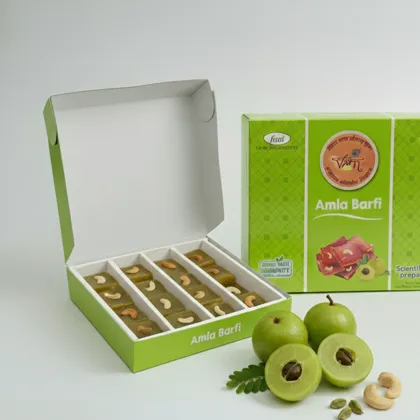
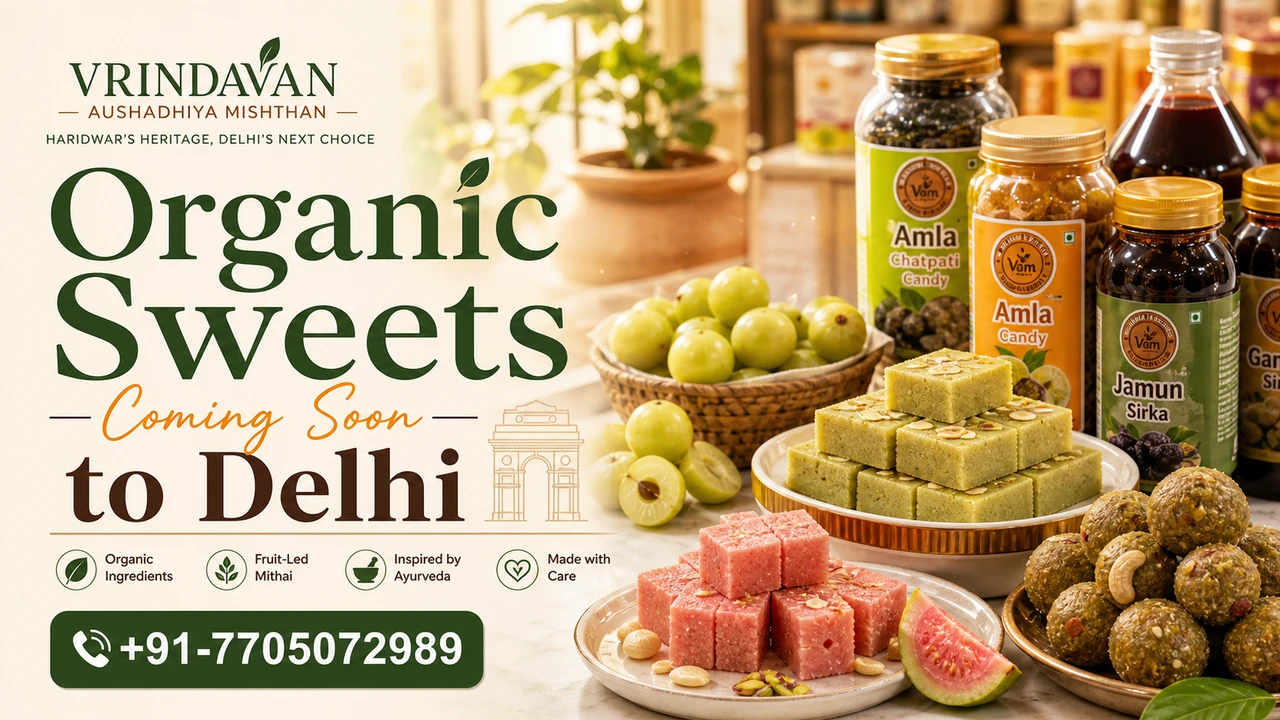
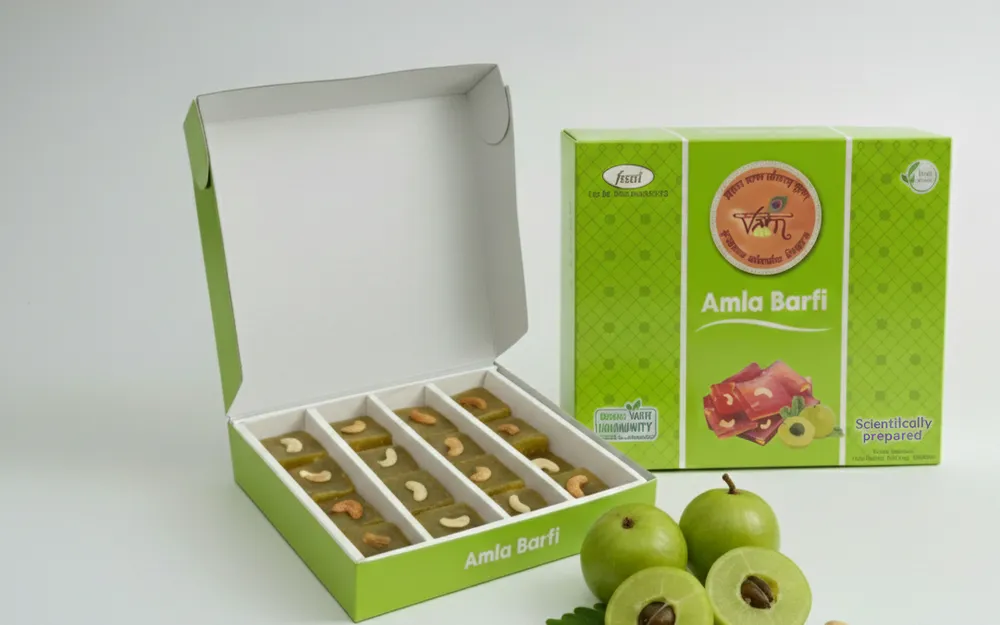
Their Amla Candy isn't made by soaking amla in a sugar syrup and calling it a day. They use a slow-dehydration process — the kind my grandmother used to do in our village in Pauri Garhwal. The amla retains its Vitamin C, its tart bite, and its digestive properties.
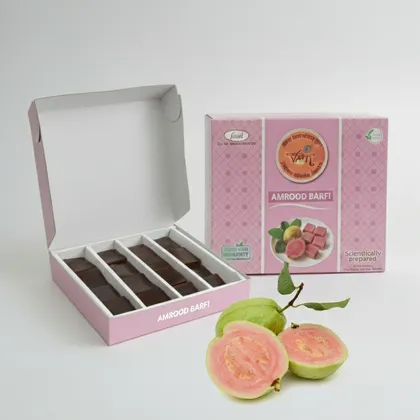
Their Guava Burfi uses actual guava pulp — not guava "flavouring." Pick up a piece and you can see the fruit fibres in it. This matters because guava is one of the richest sources of dietary fibre and Vitamin C, and when you process it minimally, those benefits carry through.
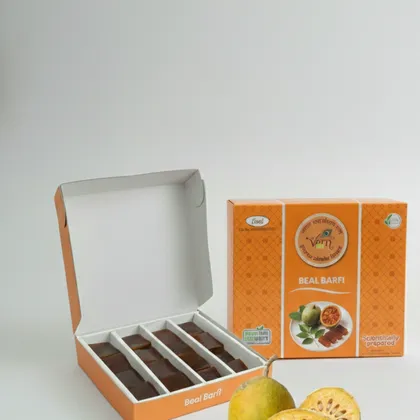
Their Bael Sweets — now this one surprised me the most. Bael (Aegle marmelos) is sacred in Ayurveda. We prescribe it for chronic constipation, IBS, and ulcerative conditions. Most people know bael sharbat, but eating it as a sweet? Vrindavan Aushadhiya figured out a way to make bael palatable as a confection while keeping the mucilage (the thick, gluey compound that heals your gut lining) intact.
That's what sets the best sweets shop in Haridwar apart from the rest. They aren't just making sweets. They're making functional foods dressed up as treats.
The Water Question — Something No Other Sweet Shop Considers
Here's something most people — even in the food industry — don't think about. In Ayurveda, we classify water into four types, and each has different properties:
1. Bhumi Jal (Earth Water / भूमि जल) This is groundwater — borewell, well water. It passes through layers of earth and picks up minerals: calcium, magnesium, iron. In Haridwar, borewell water is relatively mineral-rich because of the Himalayan geology. Ayurveda says Bhumi Jal is guru (heavy) and snigdha (unctuous) — it's nourishing but can be hard to digest if your agni is weak. Most factories and sweet shops use borewell water without any thought. They pump it, maybe filter it, and dump it into production.
2. Antariksha Jal (Sky Water / अंतरिक्ष जल — Rain Water) Rain water, in Ayurveda, is considered the purest form of water. It's laghu (light), tridosha shamak (balances all three doshas), and hridya (pleasing to the heart). Charaka specifically recommends it for medicinal preparations. Now, obviously, in polluted cities, rain water isn't practical. But the principle matters — the lighter and purer the water, the better it carries the essence of whatever you're preparing.
3. Nadi Jal (River Water / नदी जल) Haridwar sits on the banks of the Ganga, and river water has its own properties. It's considered pavitra (purifying) and has natural antimicrobial properties that modern science has also documented. The mineral content varies with season — monsoon water is different from summer water.
4. Ksheera Jal (Phala Jal — Plant Water / फल जल) This is the water found naturally inside fruits and vegetables — coconut water, the juice inside an amla, the moisture in a fresh guava. This is the most sattvic (pure, life-promoting) form of water. When Vrindavan Aushadhiya uses fresh fruit pulp in their sweets, they're inadvertently preserving this plant water — which carries enzymes, electrolytes, and micronutrients that no pipe water can replicate.
Why am I telling you about water? Because when a sweet shop uses fresh, whole fruits — as Vrindavan Aushadhiya does — you're getting the benefit of phala jal naturally. Compare that to a factory that uses fruit concentrate (which is essentially fruit boiled down, stripped of its water and fibre, then reconstituted with tap water). The nutritional profile is worlds apart.
This is one of those invisible differences that makes the best sweets shop in Haridwar genuinely different.
Jaggery vs. Sugar — The Choice That Matters
Vrindavan Aushadhiya offers every product in two variants: jaggery (gud) and sugar. This sounds simple, but it's a game-changer for health-conscious customers.
Refined Sugar:
- Stripped of all minerals during processing
- Glycemic Index: ~65 (causes rapid blood sugar spike)
- Provides "empty calories" — energy with zero nutrition
- Ayurveda classifies it as kleda-karak (creates dampness and congestion in tissues)
Jaggery (Gud):
- Retains iron, magnesium, potassium, and B vitamins from sugarcane
- Glycemic Index: ~50 (slower, more sustained energy release)
- Contains molasses compounds that aid digestion
- Ayurveda considers it raktashodhak (blood purifying) and pitta shamak (cooling to metabolic fire)
Does this mean jaggery is "sugar-free"? No. Let me be clear. Jaggery IS a form of sugar. But it's the difference between eating a whole orange and drinking a glass of orange-flavoured soda. Both contain sugar, but one nourishes you and the other depletes you.
The "Sugar-Free" Conversation — Let's Be Honest
A lot of people now search for "sugar-free sweets" and I think that term needs unpacking. Truly sugar-free sweets use artificial sweeteners — sucralose, aspartame, stevia extracts. And while these don't spike blood sugar the way cane sugar does, they come with their own concerns.
What Vrindavan Aushadhiya offers is a healthier alternative. Their jaggery-based sweets and fruit-based sweets have significantly lower processed sugar than a conventional Rasgulla or Gulab Jamun. A single Rasgulla can contain 25-30 grams of refined sugar. Their Amla Candy? The sweetness comes predominantly from the fruit's natural sugars and a controlled amount of jaggery or minimal sugar.
For my diabetic patients, I recommend their jaggery variants in moderation — a piece or two after meals, not as a snack. It's infinitely better than the deep-fried, syrup-soaked alternatives that most sweet shops in Haridwar sell.
Three Locations, One Standard
Jwalapur Store (D-10) — Their main production unit. Clean, well-organised. B-13 BHEL Store — Near Chinmaya Degree College, Shiv Mandir Road. Identical product quality. Navoday Nagar Store — Near Butterfly School Gate No. 2, Oxford School Road. Serves the residential side of Haridwar.
My Honest Assessment
After thirty years in Ayurveda, I've become immune to marketing claims. But some things speak for themselves. When I pick up a piece of their amla candy and I can taste the kashaya rasa (astringent taste) alongside the sweetness, I know the fruit hasn't been processed to death.
Is Vrindavan Aushadhiya the best sweets shop in Haridwar? From a health perspective, from an Ayurvedic perspective — yes. Unequivocally.
Vrindavan Aushadhiya Misthan Team
हरिद्वार की सर्वश्रेष्ठ मिठाई दुकान — वृंदावन औषधीय मिष्ठान क्यों सबसे अलग है
वृंदावन औषधीय मिष्ठान टीम
मैं आपसे ईमानदारी से बात करूँगा। मैंने अपने जीवन का बड़ा हिस्सा लोगों को मिठाई खाना बंद करने की सलाह देते हुए बिताया है। तीस साल से अधिक समय से उत्तराखंड में आयुर्वेद का अभ्यास करने वाले व्यक्ति के रूप में, मैंने एक पूरी पीढ़ी को औद्योगिक मिठाई से बीमार होते देखा है।
आधुनिक भारतीय मिठाइयों की समस्या
आयुर्वेद में हम आहार को स्वास्थ्य की नींव मानते हैं। चरक संहिता कहती है: "आहार सम्भवं वस्तु रोगाश्च आहार सम्भवाः"
वृंदावन औषधीय क्या अलग करती है
असली फल। असली विधि। असली धैर्य।
उनकी आंवला कैंडी धीमी निर्जलीकरण प्रक्रिया से बनती है। उनकी अमरूद बर्फी में असली अमरूद का गूदा है। उनकी बेल मिठाई में श्लेष्मा बरकरार है।
पानी का प्रश्न — चार प्रकार का जल
1. भूमि जल — भूजल। भारी और स्निग्ध। 2. अंतरिक्ष जल (वर्षा जल) — सबसे शुद्ध। लघु, त्रिदोष शामक। 3. नदी जल — शुद्धिकारक गुणों वाला। गंगा जल। 4. फल जल — फलों के अंदर का प्राकृतिक पानी — सबसे सात्विक जल।
गुड़ बनाम चीनी
गुड़ में लोहा, मैग्नीशियम, और बी विटामिन बरकरार रहते हैं। क्या गुड़ "शुगर-फ्री" है? नहीं। लेकिन यह संतरा खाने और सोडा पीने का अंतर है।
मेरा आकलन
क्या वृंदावन औषधीय हरिद्वार की सर्वश्रेष्ठ मिठाई दुकान है? स्वास्थ्य और आयुर्वेद के नज़रिए से — हाँ। बिल्कुल।
Vrindavan Aushadhiya Misthan — 3 Locations, Haridwar
W3QF+4M Haridwar, Uttarakhand
Visit the Best Sweets Shop in Haridwar
Vrindavan Aushadhiya Misthan — 3 Store Locations · WhatsApp Delivery Available